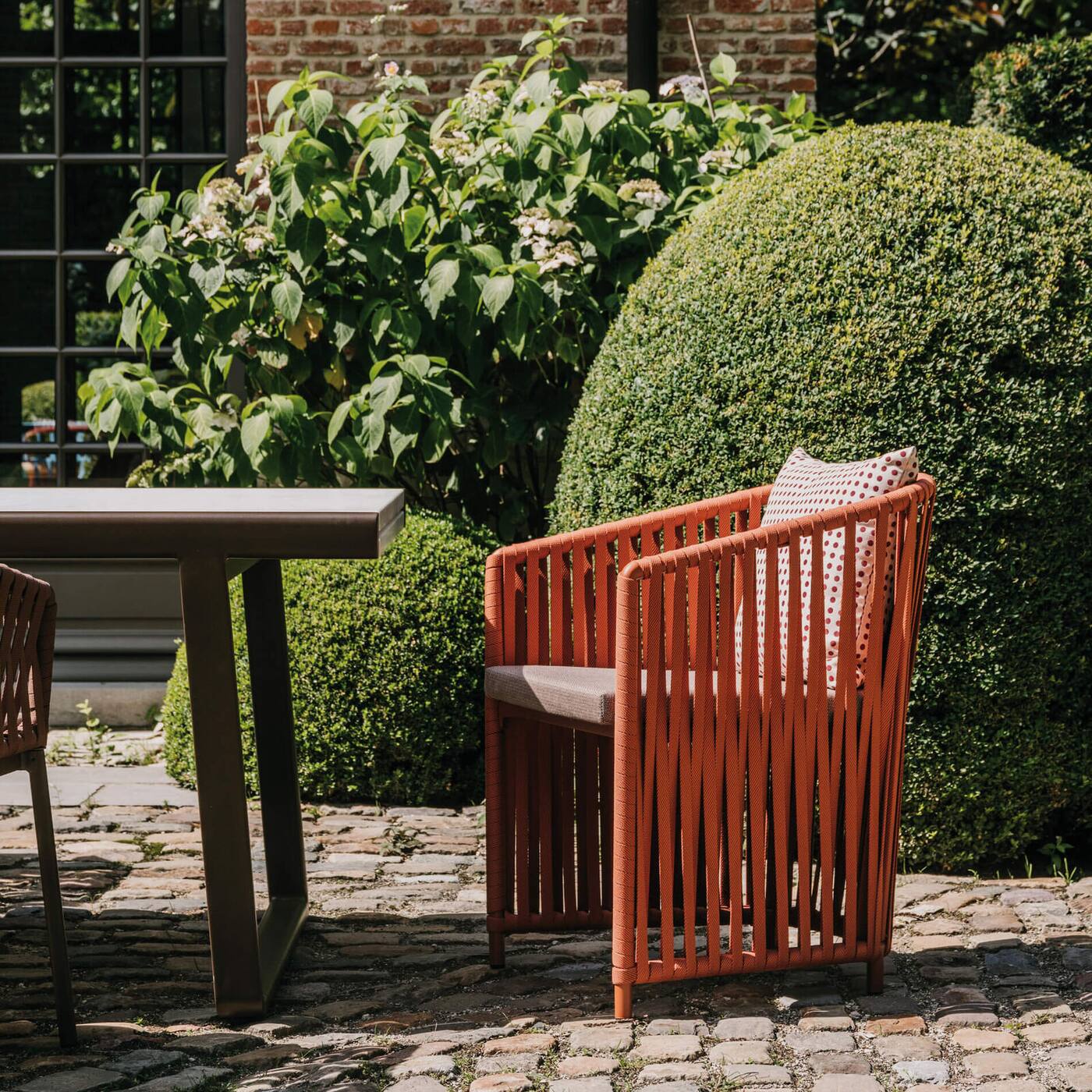
Hospitality outdoor furniture brands, what US trade specifies, zone by zone.
The European outdoor furniture brands that are specified routinely in US hospitality outdoor: hotel pool decks, resort cabanas, restaurant outdoor dining, rooftop bars, and spa garden zones. Brand-by-brand selection by zone, contract-grade documentation requirements, and the workflow that runs from signed spec to installed delivery in 16-26 weeks.
Updated June 2026 — pricing brackets, lead-time ranges, and certification thresholds in this guide reflect 2026 market data from European outdoor furniture manufacturers.
Why European outdoor dominates US hospitality contract
At the premium tier of US hospitality outdoor — luxury hotels, destination resorts, fine-dining outdoor terraces, signature rooftop bars — the dominant specification is European. The reasons are material specification depth, contract documentation completeness, and design lineage with named designers attached.
The shorthand specification fact: a European premium outdoor brand will supply ASTM F1858, ANSI/BIFMA X5.4 contract grade, FSC chain-of-custody, NFPA 260 fire classification, and 10-year structural warranty as standard package. A US mass-market brand typically supplies a subset, often missing the FSC and contract-grade certification. For a hotel design team specifying a 400-piece pool deck program, this documentation gap is not negotiable.
The exception is the small US-domestic premium tier (Brown Jordan, Janus et Cie's domestic ranges, Sutherland) which supplies full contract documentation and competes directly with European premium. For the catalog under discussion here, the European depth is broader.
Brand selection by hospitality zone
Pool deck lounge
The signature zone of hospitality outdoor: hotel pool decks, resort lounge perimeters, beach club seating. The dominant European specifications:
Dedon — Dedon Fiber woven lounge (Mbrace, Kida, Mbarq, Tango). Industry-defining for premium pool deck.
Paola Lenti — color-rich woven lounge and modular sectional. Italian designer aesthetic.
Tribù — Belgian premium lounge in woven fiber and FSC teak.
Manutti — Belgian premium woven lounge at a more accessible trade tier than Dedon.
European premium brands routinely supply the full package as standard with the invoice; the cost is built into the trade pricing. US mass-market brands typically supply a subset. For hospitality contracts the subset is the disqualifying gap.
Standard collections, 3-5 brand multi-zone fit-out
18-22 weeks
COM upholstery on hospitality program
20-26 weeks
Bespoke dimensions or contract SKU modification
22-26 weeks
Large volume (250+ pieces single-brand)
22-28 weeks
Combined multi-brand + COM + bespoke + large volume
26-34 weeks
For the canonical hospitality outdoor project — 200 to 400 pieces across pool deck, restaurant terrace, rooftop, and cabana, with hospitality-grade COM upholstery — plan a single 22-26 week production cycle from signed spec to installed delivery. See the FF&E procurement workflow for the full sequence.
Warranty structure at contract grade
Component
Hospitality contract warranty
Aluminum frame (structural)
5-10 years against corrosion
FSC teak (structural)
10 years
Powder-coat finish
3-5 years
Woven fiber (Dedon Fiber, Cane-line Soft Rope, Tribù braid)
Hospitality vs residential warranty
On the same brand, the same SKU sometimes carries different warranty terms when specified for hospitality vs residential service. A residential warranty assumes single-family-home use; a hospitality contract warranty assumes high-turnover commercial use. Some manufacturers publish a separate hospitality SKU (frame-reinforced, foam-density-upgraded, fabric-grade-upgraded) with a longer warranty than the residential equivalent. Specify the hospitality SKU when the use case is hospitality, not the residential equivalent.
Where US brands belong in the specification
European premium dominates this catalog's coverage, but US-domestic premium brands belong in specific zones of US hospitality specification:
Service speed — US-domestic stock ships in 3-6 weeks vs 14-22 weeks for European programs. When a hospitality project is in close-out and a missing piece needs replacement, US-domestic stock is the fix.
US warranty service — domestic claim turnaround is faster than European-to-US claim service.
Pricing tier below European premium — Janus et Cie's residential lines and Brown Jordan's mass tier sit below European premium price-wise; useful for budget zones in mixed-tier projects.
Hospitality outdoor failure is not random. Each zone has a characteristic failure pattern that the specifier can anticipate and spec around. Failure to do so accounts for most year-3 warranty escalations.
Pool deck
Chlorine binder degradation on cushion fabric (year 2-3). Standard Sunbrella binder breaks down under daily chlorine spray; cushion looks fine, tensile strength halves. Spec Bella-Dura olefin at the pool perimeter for properties with chlorinated water; reserve Sunbrella for the dry-zone lounge.
SPF-50 yellowing on light cushions (irreversible by year 2). Avobenzone in chemical sunscreen yellows light-color acrylic. Either spec dark colors or Sunbrella Renaissance with Crypton finish at lounger contact zones.
Aluminum frame pitting within 1,500 ft of saltwater. Standard polyester powder-coat fails by year 2. Spec marine-grade anodized (Fast, Kettal) or epoxy-primed lines only.
Strap-chair webbing fatigue at 200+ daily cycles. Olefin straps fatigue at the rivet 18-22 months in. Spec full-frame stack chairs or solid-seat lounge frames.
Restaurant terrace and dining
Edge wear on luxury woven dining seats. Hand-woven yarn at the seat-edge cup fails at 200 daily covers within 14 months. Spec Cane-line Connect, Manutti Kobo, or Tribù Senja for high-cover dining; save luxury woven for the lounge.
Teak surface gouging from cutlery and ramekins. Soft-grained teak fails the daily-reset duty cycle. Spec teak only for lounge surfaces; use HPL or aluminum tops in dining.
Cast-aluminum chair-on-stone noise complaints. Acoustic consultants flag aluminum dining noise on slate or limestone floors. Spec felt glides at install or shift to wood-base chair frames.
Stack-chair wall scuffing at storage zone. 8-chair stacks scuff finishes. Build stacked-storage padding into the FF&E spec.
Rooftop bar / terrace bar
Wind events lifting under-12 lb cast chairs. Building code and liability — spec extruded aluminum at 18+ lbs per chair or ballasted bases above the 12th floor.
Fire-code restriction on combustible furniture (Title 19, IBC Ch 25, NYC rooftop assemblies). Teak is restricted; spec aluminum or steel framing with teak veneer over non-combustible substructure where the aesthetic intent requires.
Cocktail spill on light-color fabric. Red wine and orange-bitter cocktails stain Sunbrella Canvas range. Spec Crypton Outdoor on bar perimeter; reserve Canvas for the lounge tier.
UV intensity above 2,500 ft elevation. Mile-high city rooftops compress UV warranties by 15-25%. Build cushion replacement into the year-3 budget, not year 5.
Hotel lounge and signature moments
Cigarette and ember scarring on luxury woven. Cigar bars and resort smoking sections push burns through Dedon Fiber Premium. Spec a parallel "smoking-allowed" zone with replaceable seat inserts, not Dedon hand-woven.
Hospitality cleaning rotation chemistry voiding warranty. Most warranty disputes trace to property cleaning contracts using disallowed chemistry (pressure washing, ammonia, steam). Build approved-chemistry training into the operator turnover document.
Operator vs design-firm spec conflicts
The most common cause of hospitality outdoor specification failure is not material choice — it is the conflict between the design firm's specification and the operator's downstream maintenance reality. Six conflict zones and how to resolve them at the spec stage.
Conflict: cleaning chemistry
Design firm: specifies Sunbrella Heritage at hospitality contract grade with 5-year warranty. Operator: contracts third-party cleaning service that uses concentrated bleach or pressure washing. Resolution: lock the approved-chemistry list into the operator turnover document at handover; the property loses warranty otherwise. Most operators do not know that pressure washing voids the warranty.
Conflict: cushion storage
Design firm: specifies premium fabric on the assumption of year-round indoor storage off-season. Operator: leaves cushions in service through winter to avoid storage labor. Resolution: in cold-climate properties, either specify materials rated for year-round exposure (limits the brand list) or write the storage protocol into the operations manual. Do not assume year-round outdoor at design.
Conflict: replacement-piece sourcing
Design firm: specifies a luxury-tier piece for a high-traffic dining zone. Operator: needs replacement within 4 weeks when a piece is damaged; luxury-tier restock is 14-22 weeks. Resolution: spec luxury at the lounge / signature anchor and premium-tier (US warehouse-stocked, faster replacement) at dining and bar. Or order 8-12% spare inventory at original spec; budget it into the FF&E.
Conflict: COM textile pass-through warranty
Design firm: specifies a custom textile to coordinate with interior fabric. Operator: discovers at warranty claim that the COM textile maker, not the furniture brand, holds the warranty pass-through. Resolution: build the textile data sheet, the 200-hour Xenon weathering pre-test result, and the textile-maker warranty into the spec package at brief stage. Do not approve COM without it.
Conflict: stacking and storage labor
Design firm: specifies Italian upholstered for the design aesthetic. Operator: needs to stow furniture for storm events or seasonal closure; Italian upholstered does not fold flat. Resolution: in storm-zone properties, design with flat-stow capability built in (Skagerak, Houe, stacking aluminum lines). Save Italian upholstered for the storm-safe indoor-adjacent lounge.
Conflict: design-intent fade vs operator refresh budget
Design firm: specifies marine-grade aluminum at premium powder-coat finish for 10-year intended life. Operator: skips year-5 powder-coat refresh to manage budget; frame warranty claim by year 8. Resolution: spec anodized (which does not require refresh) or extruded marine-grade where the coating cycle is longer. Build the year-5 coating refresh into the operations capital plan if powder-coat is specified.
Replacement and spares strategy
The single biggest gap between hospitality outdoor specifications that age well and those that do not is the replacement-and-spares strategy. Three options, each with a different cost and operations profile.
Option 1: 8-12% spare inventory at original spec, held by the operator
Cost: 8-12% added to original FF&E line, plus storage cost
Operations impact: replacements happen same-day from on-site storage. Highest service level.
When to use: signature moments, luxury-tier zones, high-traffic dining where 14-week European restock is unacceptable
Trade-off: storage space requirement, possible end-of-life surplus
Option 2: US-domestic alternate brand for replacement zones
Cost: replacement zones spec'd at US-stocked brand pricing (Janus et Cie Made in USA, Brown Jordan, Tropitone); typically below European premium
Operations impact: 3-6 week replacement from US warehouse vs 14-22 weeks European
When to use: dining, bar, and replacement-prone zones in mixed-tier properties
Trade-off: aesthetic compromise vs unified European specification
Option 3: 14-day-air shipment commitment from European supplier at contract
Cost: air freight premium of $1,400-2,200 per CBM vs ocean; supplier contract must include the air-freight commitment at warranty service
Operations impact: replacement in 14-21 days for warranty pieces; longer for non-warranty
When to use: hospitality contracts where on-site spares are unworkable and US-domestic alternates damage the aesthetic
Trade-off: requires written commitment in the supplier contract — most European brands will not include this by default
The most common operator complaint
"We waited 5 months for one chair." This is structural to European outdoor procurement and cannot be solved at the warranty stage — it has to be solved at the specification stage by choosing one of the three options above before the order is signed.
The 12 most-frequently-specified hospitality European brands
What outdoor furniture brands are specified in US hospitality?
For US hospitality outdoor at the premium tier, the most-specified European brands are Dedon, Tribù, Kettal, Roda, Cane-line, Gloster, Manutti, Paola Lenti, FAST, and Fischer Möbel. The selection varies by zone: Dedon and Paola Lenti dominate pool deck lounge; Gloster and Skagerak dominate FSC teak restaurant dining; FAST and Kettal dominate aluminum bar and dining; Tuuci and Glatz dominate parasols. Most US hospitality projects above $50,000 in outdoor scope specify three to five brands across zones rather than single-brand fit-out.
What documentation is required for hospitality outdoor furniture?
US hospitality outdoor furniture documentation: ANSI/BIFMA X5.4 lounge seating contract grade, ASTM F1858 outdoor furniture safety and durability, NFPA 260 and California Title 19 fire-code classification on all cushion components, FSC chain-of-custody where teak is specified, fabric warranty and bleach-cleanable certification (Sunbrella Contract Grade is the standard), ADA accessibility documentation on key seating models. European premium brands routinely supply all of the above with the invoice; US mass-market often supplies a subset.
What is the lead time for hospitality outdoor furniture from Europe?
Standard European hospitality outdoor configurations: 8-14 weeks factory-to-US-port. COM upholstery in hospitality grade adds 4-8 weeks for fabric shipping to European factory and cut-and-sew workflow. Large-volume hospitality (250+ pieces): 18-26 weeks because of factory production scheduling. Container consolidation across multiple brands adds 1-2 weeks. End-to-end, plan 16-26 weeks from signed spec to installed delivery for hospitality outdoor at the premium European tier.
What is the warranty on hospitality outdoor furniture?
At hospitality contract grade, European premium outdoor brands typically warrant: aluminum frames 5-10 years against corrosion, FSC teak structural elements 10 years, powder-coat finish 3-5 years, cushion fabric 3 years against UV and stitching, woven fiber 3-5 years against UV degradation. Hospitality contract grade warranty supersedes residential warranty on the same SKU; some brands publish a separate hospitality SKU with reinforced structural components and longer warranty than the residential equivalent.
What zone-specific failure modes should hospitality specifiers plan for?
Pool deck: chlorine binder fail on Sunbrella by year 2-3 (spec Bella-Dura olefin at the wet perimeter); SPF-50 yellowing on light cushions (spec dark colors or Crypton finish at lounger contact). Dining: edge wear on luxury woven at 200+ daily covers (spec Cane-line Connect / Manutti Kobo for dining, save luxury woven for lounge); teak gouging from cutlery (spec HPL or aluminum tops). Rooftop bar: wind lift on under-12 lb cast chairs above 12 stories (spec 18+ lb extruded or ballasted bases); fire-code restriction on combustible. Hotel lounge: cigarette burns on luxury woven (spec replaceable inserts in smoking zones).
How do design firm and operator specifications conflict in hospitality outdoor?
Six conflict zones: cleaning chemistry (operator's pressure-washing contract voids the design firm's warranty assumption), cushion storage (operator skips off-season storage, design firm specified Mediterranean materials), replacement-piece sourcing (luxury-tier 14-22 week restock vs operator's 4-week replacement need), COM textile pass-through warranty (textile maker holds warranty, not the furniture brand), stacking and storage labor (Italian upholstered does not fold flat for storm-stow), and design-intent fade vs operator refresh budget (operator skips year-5 coating refresh, frame warranty claim year 8). Resolve at spec stage, not at warranty stage.
What spares and replacement strategy should hospitality outdoor specifications include?
Three options: 8-12% spare inventory at original spec held by the operator on-site (same-day replacement, storage cost, end-of-life surplus risk), US-domestic alternate brand for replacement-prone zones (Janus et Cie Made in USA, Brown Jordan, Tropitone — 3-6 week US warehouse replacement, aesthetic compromise), or 14-day-air shipment commitment written into the European supplier contract (14-21 day air freight at $1,400-2,200 per CBM premium). The most common operator complaint — "we waited 5 months for one chair" — is structural to European outdoor and must be solved at specification, not warranty.
Does the published European warranty apply to hospitality projects?
No. Every European outdoor brand publishes a residential warranty as the default (5-10 years frame, 2-3 years coating, 1 year textile) that explicitly excludes "commercial use" — covering hotel terraces, restaurant patios, and HOA pool decks. The hospitality contract warranty is a separate signed addendum at +12-18% on the line price, covering heavy-use rating at 3-5 years on frame with refresh credit at year 5. Always quote the contract warranty for non-residential projects in writing; the most common quote dispute is residential warranty applied to commercial use.
Specifying for hospitality
Hospitality brand-by-zone short-list
Send the brief — property type, zones, occupancy, design intent. We come back with contract-grade documentation deliverables.
Public-space USA addition. For US national parks, university quads, and other commercial outdoor settings requiring Buy-American sourcing, the Loll Adirondack is the recycled-HDPE workhorse — colourfast, salt-resistant, made from milk-jug stock in Duluth, Minnesota.
Danish accent chair. The Mater Ocean chair (Nanna and Jorgen Ditzel, 1955, reissued in 100% recycled fishnet plastic) appears in restaurant terraces across Copenhagen and at the brand's flagship hotel installations — sustainable provenance with modernist credibility.
Hospitality shade canon. The Glatz Alu-Twist centre-pole umbrella is the workhorse for hotel pool decks and restaurant terraces — wind-rated, lockable, and tall enough for service to circulate beneath.