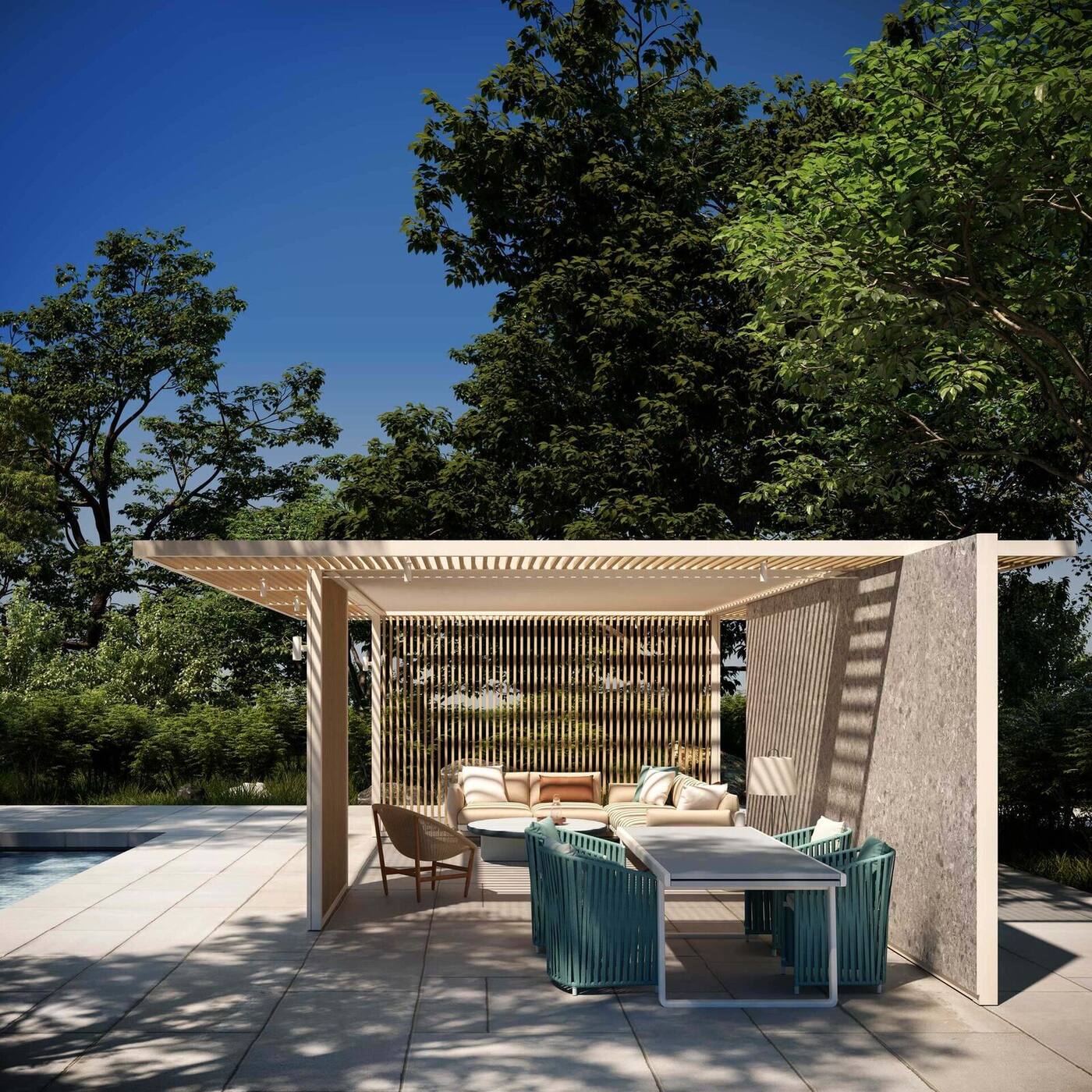
Outdoor furniture brands architects specify, the AEC reference.
What US architects, landscape architects, and interior designers actually specify on premium outdoor projects, and why. Brand-by-brand context for the residential and commercial AEC specification process, the documentation requirements that gate inclusion in the construction document set, and the workflow that brings European premium outdoor into a US architectural project.
Updated June 2026 — pricing brackets, lead-time ranges, and certification thresholds in this guide reflect 2026 market data from European outdoor furniture manufacturers.
Why architects favor European outdoor specification
The dominant share of US premium outdoor specification — residential premium, hospitality, urban landscape, civic — runs through the European catalog. The structural reasons:
Material specification depth. A European premium brand publishes material data sheets, ASTM compliance statements, FSC certificates, fire classification, and contract-grade documentation as standard. The architectural specification process needs this package to bind the design intent.
Named designer lineage. Collections designed by Sebastian Herkner (Dedon Mbrace), Patricia Urquiola (Kettal Vimini), Richard Frinier (Dedon Barracuda), Mark Gabbertas (Gloster Pepper), Henrik Pedersen (Cane-line). The named-designer attribution reads as architectural decision, not retail choice.
Scale and design coordination with architecture. European outdoor catalog reads at architectural perimeter scale. Material continuity with interior specifications (woven, FSC teak, powder-coated aluminum) lets the outdoor furniture coordinate with structural and interior architectural decisions rather than fight them.
Service-life expectation. European premium is specified for 15-30 year service life, matching the architectural service life of the structure. Mass-market outdoor (5-7 year residential cycle) does not.
The 12 most-cited outdoor brands in US architectural practice
NFPA 260, California Title 19 for cushion components
Warranty schedule
Structural, finish, fabric warranty terms
Care and maintenance
Manufacturer care guide
LEED documentation
EPD, recycled content where the project is LEED-registered
European premium outdoor brands routinely supply this entire deliverable package with the trade quote. Some brands supply BIM (Revit RFA) and CAD (DWG) at the same time; for those that do not, the procurement coordinator supplies dimensional CAD on request.
CAD/BIM availability
Brand
BIM availability
Dedon
DWG and SketchUp 3D for active catalog; Revit on request
Kettal
Full DWG, Revit RFA, SketchUp 3D published on professional portal
Gloster
DWG and PDF spec sheets; Revit on request through US distribution
Skagerak / Fritz Hansen
Full DWG and Revit RFA published through Fritz Hansen pro portal
Roda, Tribù, Manutti
DWG and dimensional PDF; Revit on request
FAST, Pedrali
DWG and SketchUp 3D; Revit on request through Italian distributor
Cane-line, Houe
DWG and SketchUp 3D published on professional portal
Specification workflow with a trade procurement coordinator
For US architects and design firms specifying European outdoor on a project, the workflow:
Design intent shared with the procurement coordinator at schematic design phase.
Brand short-list response with 3-5 brands per zone, including dimensional CAD/BIM availability, lead time, and indicative pricing.
Specification refinement at design development phase: confirm SKU, finish, fabric, COM, dimension.
Construction document inclusion with full deliverable package per SKU.
Bid release with the project's GC.
Production and installation coordinated through procurement coordinator: factory production, ocean freight, customs, US trucking, supervised installation.
The standard AIA "or-equal" specification clause is the single largest source of post-specification dispute on outdoor furniture. When the contractor or owner substitutes a "comparable" piece, the architect carries the design and performance risk unless the spec language is tight. Five clauses to include explicitly in any outdoor furniture spec.
1. Designer-attribution requirement
For designer-attributed collections (Sebastian Herkner / Dedon, Antonio Citterio / B&B Italia, Patricia Urquiola / Kettal), specify "designer-attributed by [name], no equivalents." A "Sebastian Herkner-style" substitute is not a Sebastian Herkner piece and undermines the design-intent justification at the project review.
2. Material-spec gate, not visual-match
Specify the technical material grade: "FSC chain-of-custody Grade A teak, 4-7% oil content certified by the mill, 316 stainless hardware" rather than "premium teak with stainless hardware." A "visual match" substitute typically degrades on one of the material gates that justified the original spec.
3. Warranty gate at hospitality contract grade
Specify "hospitality contract warranty 5-year on frame, 3-year on coating, 1-year on textile" rather than naming the brand. A substitute that meets the warranty gate without meeting the brand attribution is acceptable; a substitute that meets the brand name but not the warranty gate is not.
4. Lead-time and replacement-piece commitment
Specify "14-day air-freight commitment on warranty replacement pieces, written into the supplier contract." This converts the lead-time concern from an architect-design problem into a contractor-procurement problem. Substitutes that cannot meet the air-freight commitment are not equal.
5. Documentation deliverables
Specify the documents required at delivery: FSC chain-of-custody, ASTM F1858 compliance certificate, ANSI/BIFMA X5.4 lounge seating, NFPA 260 cushion fire classification, California Title 19 documentation, and ADA accessibility on key SKUs. A substitute that cannot deliver the documentation package is not equal regardless of visual or material match.
With these five clauses, the substitution conversation moves from "is this brand visually similar" to "does this brand meet the contractual gates." The architect is protected from carrying the consequences of a substitution that fails one of the gates.
Spec failure post-mortem: what gets blamed on the architect
Five outdoor furniture failure patterns recur in US architectural practice. Each is blamed on the architect at the owner-operator post-mortem; each is recoverable at the specification stage with the right language.
"The cushions are stained / yellowed by year 3." Root cause: residential-warranty fabric specified for hospitality duty cycle, or light-color acrylic at lounger SPF-50 contact zones. Spec gate: hospitality contract warranty on fabric grade, dark colors or Crypton finish at lounger zones, written approved-chemistry list at operator turnover.
"The aluminum frame finish failed by year 5." Root cause: standard powder-coat specified for coastal property, or operator skipped year-5 refresh on a 10-year coating. Spec gate: marine-anodized or epoxy-primed within 1,500 ft of saltwater, year-5 coating refresh budgeted in capital plan, replacement-piece commitment in supplier contract.
"We waited 5 months for one replacement chair." Root cause: luxury or specialty European brand specified without a replacement-piece commitment. Spec gate: 14-day air-freight commitment in supplier contract, or 8-12% spare inventory at original spec held by operator on-site, or US-domestic alternate brand for replacement-prone zones.
"The teak silvered unevenly and the owner is unhappy." Root cause: design-intent on "natural patina" not communicated to operator, who applied sealer or pressure-washed. Spec gate: written patina specification in the operations manual, factory-approved cleaning routine, designer's color-progression intent documented.
"The modular sectional cannot be reconfigured for our weekly event." Root cause: modular sectional specified where multi-event flexibility was needed. Spec gate: stack-chair and bistro-table program for event-flexible zones; modular reserved for destination lounge only.
The architect-protective spec
A tight outdoor furniture specification is not about constraining the contractor or operator; it is about protecting the architect from carrying the consequences of substitutions and operations decisions made downstream. The five clauses above and the gates above move the risk to the parties who actually make the decisions.
Code compliance reality by US jurisdiction
The headline codes (IBC, ADA, NFPA) apply nationwide, but the specific code interpretations that affect outdoor furniture specification vary by city and state. Five jurisdictions and the spec implications.
New York City (rooftop and assembly)
Rooftop assemblies above the 6th floor: non-combustible furniture required under the NYC Building Code interpretation. Teak permitted only as veneer over non-combustible substructure.
Public-assembly outdoor (restaurants, hotels, public terraces): ADA accessibility on a percentage of seating, with knee-clearance and aisle-width requirements.
FDNY rooftop occupancy rules govern furniture quantity and arrangement by deck square footage.
California (Title 19, T-24, Prop 65)
Title 19 fire-code documentation on cushion components, mandatory for hospitality and public-assembly outdoor.
Title 24 energy code interaction: exterior furniture in conditioned spaces affects the building energy compliance calculation.
Prop 65 chemical disclosure: many treated woods and fabrics carry Prop 65 warnings; the architect should know which products trigger and how to brief the owner.
Miami-Dade (hurricane and salt-air)
Wind-load engineering for above-grade outdoor: chairs above 12 stories require ballast or weight-loading equivalent to Miami-Dade hurricane protocol.
Salt-air exposure within 1,500 ft of saltwater: marine-grade aluminum and 316 stainless required for warranty compliance; standard residential outdoor will not deliver the 10-year service life expected at project sign-off.
Chicago (high-rise terrace, lake-effect freeze)
High-rise terrace assembly limits — wind-load and combustibility considerations similar to NYC, applied differently by the Chicago code amendments.
Off-season freeze-thaw exposure compresses warranty cycles 15-20% on Mediterranean-spec materials. Spec northern European (Skagerak, Houe, Cane-line Danish series) or commit to off-season storage protocol.
Texas (Austin, Dallas, Houston — heat and rapid-growth properties)
Surface temperatures above 175°F on dark cushions and dark aluminum frames in Phoenix-Tucson-Austin summers. Specify light colors or high-mass shading at lounger zones.
City of Austin sustainable-building standards request FSC documentation on teak content at large projects.
Houston flood-exposure considerations on ground-level outdoor at certain elevations; cushion materials should drain.
The pattern: the architect's spec is judged at the owner-operator level against the local code interpretation and the local exposure reality. A spec that meets the national code but fails the local interpretation is the most common path to a post-occupancy dispute.
Frequently asked
What outdoor furniture brands do architects specify?
US architects and landscape architects most frequently specify the European premium outdoor catalog: Dedon, Tribù, Kettal, Gloster, Roda, Cane-line, Paola Lenti, Manutti, FAST, Skagerak, Glatz, and Tuuci. Specification depth follows design intent: for residential premium, Dedon and Paola Lenti dominate lounge while Gloster dominates teak dining. For commercial AEC, Kettal and FAST add architectural modular and aluminum capability. For landscape architecture installations, Skagerak and Barlow Tyrie supply the FSC teak benches that read as permanent architectural elements. Read more about Glatz Alu-Twist.
Why do architects specify European outdoor furniture brands?
Three reasons drive the European specification preference. First, material specification depth: a European premium brand supplies full ASTM, FSC, fire-code, and contract-grade documentation as standard. Second, named designer lineage: collections by Sebastian Herkner, Patricia Urquiola, Richard Frinier, Mark Gabbertas read as architectural decisions, not retail choices. Third, the catalog has the design language to coordinate with architectural intent — material continuity with interior, scale appropriate to architectural perimeter, finish range that holds against permanent structure.
What documentation do architects need for outdoor furniture specifications?
For inclusion in the architectural construction document set: complete dimensional drawings (plan, elevation, section), material specification sheet, finish specification, ASTM F1858 compliance statement, FSC certificate where teak is specified, fire-code classification for cushion components, ANSI/BIFMA X5.4 for hospitality contract use. For LEED-registered projects, add Environmental Product Declaration (EPD), recycled content documentation, and material life-cycle assessment. European premium outdoor brands supply this documentation package as standard with the quote.
Can outdoor furniture be specified in CAD/BIM workflows?
Yes. Most European premium outdoor brands publish DWG, Revit family (RFA), and SketchUp 3D models for the active catalog. These are downloadable from the manufacturer's professional portal after trade qualification. For brands without published BIM, sourcing coordinators (us, and equivalents) can supply dimensional CAD on request. For specification-grade renders, manufacturer image libraries are accessible at high resolution under signed trade NDA.
How should "or-equal" language be written to protect the outdoor furniture specification?
Five clauses to include: designer-attribution requirement (for Sebastian Herkner, Citterio, Urquiola, etc. — no "in the style of" equivalents accepted), material-spec gate stated as technical grade (FSC Grade A teak, 4-7% oil content, 316 stainless hardware — not "premium teak"), warranty gate at hospitality contract grade rather than brand name, 14-day air-freight commitment on warranty replacement written into the supplier contract, and documentation deliverables (FSC chain-of-custody, ASTM F1858, ANSI/BIFMA X5.4, NFPA 260, Title 19, ADA). These convert the substitution conversation from visual match to contractual gates.
What outdoor furniture failures get blamed on the architect at post-occupancy review?
Five recurring patterns: stained or yellowed cushions by year 3 (residential warranty fabric on hospitality duty cycle — spec hospitality contract warranty, dark colors at lounger zones), aluminum frame finish failure by year 5 (standard powder-coat at coastal property — spec marine-anodized within 1,500 ft of saltwater), 5-month wait for one replacement chair (no replacement-piece commitment — spec air-freight clause or 8-12% spare inventory), uneven teak silvering with unhappy owner (design-intent on natural patina not communicated — spec written patina specification in operations manual), and modular sectional that cannot reconfigure for events (modular specified where flexibility was needed — spec stack chairs for event zones, modular reserved for destination lounge).
How does outdoor furniture code compliance vary by US jurisdiction?
NYC: non-combustible furniture required on rooftops above the 6th floor (teak permitted only as veneer over non-combustible substructure), FDNY occupancy rules on furniture quantity and arrangement. California: Title 19 fire-code on cushions, Title 24 energy code interaction in conditioned outdoor spaces, Prop 65 chemical disclosure. Miami-Dade: wind-load engineering on above-grade outdoor, marine-grade aluminum and 316 stainless within 1,500 ft of saltwater. Chicago: high-rise terrace combustibility, freeze-thaw compresses Mediterranean-spec warranties 15-20%. Texas: surface temperatures above 175°F on dark cushions in summer, Austin sustainable-building standards request FSC documentation. A spec that meets national code but fails the local interpretation is the most common path to post-occupancy dispute.
Architect specification
AEC brand short-list with BIM availability
Send the project brief — type, zones, CAD/BIM format, documentation requirements. We come back with full deliverable package.